


TL; DR (For the busy sponsors & feasibility leaders)
- Traditional study feasibility in clinical trials focuses on site capability and operational readiness but often overlooks direct patient validation.
- Many clinical trial recruitment challenges, protocol amendments, and enrollment delays stem from unvalidated patient assumptions.
- Patient-centric feasibility helps assess inclusion and exclusion criteria, study burden, geographic variation, and diversity strategy before study launch.
- Integrating patient insights into clinical trial feasibility planning improves recruitment performance, reduces avoidable protocol amendments, and de-risks study timelines and budgets.

Sponsors invest significant amounts of time and resources into feasibility assessments before launching a clinical trial. Sites are evaluated, regulatory timelines are mapped, budgets are scrutinized.
- Yet recruitment timelines remain unpredictable
- Enrollment curves rarely match projections
- Protocol complexity continues to increase
- Competition for eligible patients intensifies globally
But there’s one critical variable that often remains under-validated: the patient.
How many of these risks originate not at the program/study/site level but at the patient level?
A note from Fenja Kruse, Team Lead Patient Insights, Clariness
“Who wants to go first?” Few of us ever volunteer. In healthcare, that hesitation is even stronger. Fear of side effects often outweighs hope and trust in something better and that’s completely understandable. Nothing matters more than our health. It’s not just potential participants who feel this way; doctors do too. They carry enormous responsibility.
Yet we talk far too little about the different phases of a clinical trial. Before anyone joins a study that fits their specific condition, a treatment has already gone through multiple rounds of testing carefully designed, closely monitored, ethically reviewed.
Participants become part of a scientific community supported by experience, research, and shared progress. Step by step, phase by phase.
What’s often missing isn’t safety, it’s awareness. We need more information, more transparency, more education around how clinical trials actually work. Because understanding builds trust. And trust makes it easier to take that first step, knowing there is a safety net in place.
The outdated approach to study feasibility

Traditional feasibility typically operates across three levels: Program level > Study level > Site level
| Feasibility level | Scope | Focus | Example key question |
| Program level | Therapeutic area / multiple studies | Regional strategy | Is this disease area viable in this region? |
| Study level | One specific clinical trial | Protocol practically | Can this specific study run successfully here? |
| Site level | Individual hospital or investigator | Operational capability | Can this site execute the trial properly? |
The traditional feasibility model heavily focuses on operational readiness:
- Historical enrollment performance
- Epidemiological projections
- Investigator interest and experience
- Regulatory and startup timelines
- Site infrastructure and staffing
While these factors are essential, they are largely based on estimations and sometimes, even, particularly when it comes to patient behavior. Sites may estimate they can recruit a certain number of patients, but inputs from a conventional feasibility study rarely answer deeper questions:
- Will patients accept the visit schedule?
- Are the inclusion and exclusion criteria realistic in real-world populations?
- Is the study burden manageable?
- Does the disease severity influence willingness to participate?
- Are there cultural or geographical differences that impact recruitment?
Without directly validating these variables, feasibility remains incomplete.
What is the most essential layer that is often missed? Direct patient insight

Modern study feasibility in clinical trials must extend beyond operational capability and into patient reality. Studies leveraging patient insights recruit approximately 30% more patients. This is not accidental, it reflects the impact of designing studies aligned with patient expectations, needs and constraints.
Patient-driven feasibility can uncover critical insights before a study launches.
1. Inclusion & exclusion trade-offs
Strict criteria may protect data integrity but at what cost to recruitment? Direct patient feedback can reveal:
- How many patients truly meet the criteria in real-world settings
- Whether certain exclusions unnecessarily limit your pool
- The willingness of eligible patients to participate under proposed conditions
This insight can prevent costly mid-study amendments.
2. Study burden and participation barriers
Even eligible patients may decline participation due to visit frequency, travel requirements, invasive procedures, time commitments, lack of decentralized options. Understanding these barriers in advance allows sponsors to refine protocol design before activation rather than reacting after enrollment stalls.
3. Disease severity and motivation
Recruiting dynamics vary significantly depending on disease state:
- Patients with mild symptoms may see little incentive to participate
- Patients with severe disease may struggle with compliance due to physical limitations
- Caregiver burden may impact retention in certain indications
Validating these dynamics early on, improves forecasting accuracy and retention planning.
4. Geographic and diversity considerations
Feasibility often assumes a uniform patient population across countries. In reality:
- Target populations vary by geography
- Ethnic representation differs significantly
- Cultural perceptions of clinical trials influence willingness to enroll
Patient insights play a crucial role in identifying which countries genuinely host the intended target population and where diverse patient groups can be effectively accessed. They also help determine how recruitment messaging should be adapted to align with local cultural, social, and linguistic contexts. This becomes especially important as sponsors increasingly prioritize diversity, equity and inclusion (DE&I) strategies in clinical research.
The cost of ignoring the patient perspective

When patient realities are not integrated into feasibility planning, consequences surface later, often expensively.
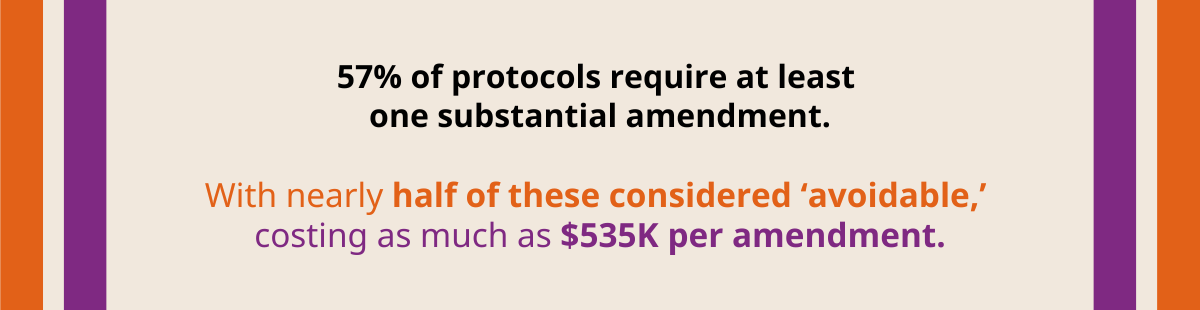
- 57% of protocol undergo at least one substantial amendment
- Nearly half of these considered “avoidable”
- Each amendment can cost up to $535,000
- Recruitment delays cost sponsors between $600K & $8M per day in lost sales
Many of these issues stem from enrollment challenges that could have been identified earlier through direct patient validation. Feasibility should not merely assess whether a site can run the study, it should assess whether patients will join it.
What patient-driven feasibility looks like in practice

At Clariness, patient insight generation is built on over 20+ years of clinical research experience and more than one million patients surveyed globally. Our approach to patient-driven feasibility includes:
1. Objective-driven design
- Clear understanding of your study objectives and hypotheses
- Identification of key comparisons and critical questions
- Survey structured to generate meaningful, decision-ready insights
2. Direct access to your target population
- Engagement of “True Completers” who precisely match your criteria
- 100% survey completion to ensure robust datasets
- Insights derived exclusively from your intended audience
3. Interdisciplinary collaboration
- Surveys developed by in-house psychologists and health scientists
- Close collaboration across medical, patient insights, and marketing teams
- Balanced approach combining scientific rigor and practical relevance
4. Engineered for high completion rates
- Patient population research conducted before survey development
- Appropriate terminology and complexity tailored to the audience
- Designed to be accessible, understandable and easy to complete
5. Patient-centric structure & flow
- Survey journey designed from the patient’s perspective
- Streamlines flow and optimized question formats
- Reduced burden to improve engagement and completion
6. Proven performance at scale
- Insights informed by surveying over 1 million global patients worldwide
- Continuous optimization based on performance data and lessons learned
- High-performing surveys that remain patient-friendly and reliable
See what a client says about our patient-centric approach to feasibility planning:

“We hope to set a new industry standard for study reviews, and in doing so, create better trial experiences for patients and sites.
Clariness provides us with unfiltered access to patient voices, which allows us to create better patient experiences at every stage of our study.”
– Head Feasibility, CDO, Bayer Pharma AG.
With insights drawn from more than 1,500 studies, including the industry’s largest trial diversity study, capturing over 250,000 datapoints from 6,000+ patients across 9 countries; Clariness brings unparalleled depth to study feasibility planning.
Our data goes beyond assumptions, providing real-world patient intelligence to help you assess where, how and with whom your study can succeed.
From strengthening recruitment projections, optimizing protocol design to selecting the right countries and sites, our patient insights help de-risk feasibility decisions and set your trial up for success.
Build your study with better feasibility!
FAQs:
1. What is a feasibility study in clinical trials?
A feasibility study in clinical trials is a structured pre-study assessment that evaluates site capability, patient availability, protocol complexity, and regulatory requirements to determine whether a trial can be successfully executed.
2. What is the purpose of a feasibility study?
The purpose of a feasibility study is to identify recruitment risks, prevent costly protocol amendments, optimize site selection, and ensure the study can meet its enrollment targets, timelines and budget.
3. What are the steps in conducting a feasibility study?
The key steps in conducting a feasibility study include assessing patient availability, evaluating site capability, reviewing protocol complexity, analyzing regulatory timelines, validating recruitment projections, and identifying potential risks such as enrollment challenges or protocol amendments.
4. Why is patient recruitment the biggest feasibility risk?
Patient recruitment is a major feasibility risk because inaccurate enrollment forecasts, restrictive inclusion/exclusion criteria, and high study burden can delay trials and increase costs.
5. How do patient insights improve clinical trial feasibility?
Patient insights validate willingness to participate, identify enrollment barriers, and assess protocol burden. Clinical trials using patient-driven feasibility can improve recruitment rates and reduce avoidable amendments.

Author: Mercy Hapsiba, Content Marketing Specialist | Post Date: 03.03.2026