Patients, sites, & sponsors: Tackling three key challenges in obesity clinical trials
Blog
Metabolic disordersObesity
Share insight
This blog outlines the top three challenges that patients, sites and sponsors face in obesity clinical studies.
Obesity has become one of the most pressing global health challenges. Today, around 1 billion people are living with obesity. By 2035, it is projected that about half of the population worldwide will be living with overweight or obesity. Against this backdrop, obesity clinical trials are becoming increasingly important to develop new and effective treatments. This blog outlines the top three challenges that patients, sites and sponsors face in obesity clinical studies and how they can be effectively addressed.
Top three challenges patients face in obesity clinical trials
1. Stigma and trust barriers
For many individuals living with obesity, the decision to participate in a clinical trial is shaped by past healthcare experiences. Weight bias and stigma remain widespread in medical settings, often to feelings of shame, judgement, or dismissal.
This psychological barrier can significantly impact recruitment. Patients may hesitate to engage with research opportunities if they fear being blamed for their condition or not being treated with empathy and respect. Building trust is therefore not only ethical but also operationally critical. In obesity trials, recruitment strategies must foster awareness, dignity, understanding and patient-first communication.
2. Complex eligibility criteria
Obesity trials frequently involve strict inclusion and exclusion criteria including specific BMI thresholds, and medical records of prior weight-loss treatments. While scientifically necessary, these criteria often lead to high screen-failure rates. Many motivated patients complete initial screening only to discover they do not qualify.
This creates frustration, reduces trust in research participation, and increases the burden on both patients and sites. For patients, repeated ineligibility can discourage future participation, limiting long-term engagement within the area of clinical research.
3. Long-term commitment and lifestyle burden
Unlike short-duration studies, many obesity trials extend over several weeks or longer. For example, a randomized obesity study published in the International Journal of Obesity, states that a 52-week digital behavioral support intervention in adults with overweight or obesity was followed for five years.
Participants may be required to attend frequent site visits, complete lifestyle assessments, track diet and physical activity, and undergo metabolic testing. For patients balancing work, caregiving responsibilities, and daily life demands, this level of commitment can be challenging. Travel time, appointment frequency, and side effects from treatments may further impact adherence.
How these challenges can be addressed
A patient-centric recruitment and engagement strategy can significantly reduce these barriers. Using stigma-sensitive communication and inclusive language in outreach helps build trust and encourages patients to explore clinical trials without fear of judgement. Clariness regularly runs patient insight surveys to ensure we use the terminology that resonates most with patients, including sensitive messaging, which drives higher engagement rates with our campaigns.
Advanced pre-screening tools allow interested participants to check eligibility earlier in the process, reducing frustration caused by screen failures. Additionally, ongoing engagement strategies, such as clear study materials, patient education, and digital engagement tools, can help maintain motivation throughout long study durations and support long-term retention.
What motivates patients to participate in obesity clinical trials
In a 2024 patient survey conducted by Clariness, several key insights emerged about patient interest and barriers to participation in obesity clinical trials.
Here are the key findings:
> Just over ¼ of respondents had already investigated clinical studies on the topic of weight loss. > Facebook is by far the most frequently mentioned source of information. > In our sample, less than 10% of participants had participated in a study or registered but were then not accepted for the study. > Just over 70% can imagine participating in genetic study. > Just over 60% can imagine testing a new medication as part of a weight loss study. > Just over 40% can imagine trying a new surgical procedure as part of a clinical study.
The biggest hurdles for potential study participants were possible travel expenses, fear of side effects and the lack of knowledge about clinical studies. Key motivators for participation included close medical monitoring during the study, compensation for time, and travel expenses, and access to new treatment options.
As of today, there are 800+ clinical trials planned and recruiting patients for obesity treatments. Here are a few of the largest ones in the news currently:
Amgen’s Phase 2 obesity study evaluating MariTide, a once-monthly treatment that demonstrated significant weight loss and cardiometabolic improvements after 52 weeks.
Lilly’s obesity clinical trial, TRIUMPH-7, is investigating a potential treatment aiming at helping adults with weight management and chronic lower back pain.
Top three challenges sites face in obesity clinical trials
1. High screening volume with low conversion
Because of narrow eligibility criteria obesity trials often require a large volume of pre-screened candidates to achieve the targeted enrollment. Sites may evaluate dozens of patients to randomize only a small fraction. This creates an operational strain leading to increased administrative workload, repeated laboratory testing, higher staffing demands, and greater coordination efforts.
High screen-failure rates translate into increased time and cost at the site level. Without optimized pre-screening and targeted outreach, site teams can quickly become overextended.
2. Growing competition for the same patient population
The obesity therapeutic landscape is expanding rapidly, with multiple sponsors investigation GLP-1 receptor agonists, combination therapies, and next-generation metabolic treatments. As a result, sites may run several obesity or metabolic trials simultaneously, often recruiting from the same patient pool. This may intensify competition and slows enrollment across studies.
Sites must prioritize protocols, manage overlapping recruitment timelines, and navigate patient expectations when multiple opportunities are available.
3. Retention and patient support responsibilities
Obesity trials are behaviorally and emotionally complex. Beyond protocol execution site staff must address patient concerns, manage side effects, and reinforce motivation for participants over extended durations.
Retention requires continuous communication and relationship management. This adds an additional layer of responsibility beyond standard clinical oversight.
How these challenges can be addressed
Campaigns at Clariness provide sites with only high-quality pre-screened patient referrals, not only this, but the campaigns are set to a pre-agreed radius of the site location, this reduces burden and improves conversion rates. Further, our Enrollment Success Team align with our clients’ sites on capacity and schedules during the set-up phase, we then set the capacity in our ClinLife® portal so that all sites are never over capacity for our referrals. Once a site reaches max capacity, our campaigns automatically pause until patients have been processed, this leads to increased conversion of referrals, but also, we can reallocate budget to lower performing site locations.
Additionally, providing patient engagement resources and educational materials can support retention efforts and help sites maintain consistent communication with participants throughout the study.
Read what our Site Partnership Manager said about a recent obesity study:
“From my perspective, this study is going well mainly because the cooperation with the site has been very strong. We’ve had effective email and phone communication, the PI is highly dedicated, and even the patients are proactive, which makes a big difference in obesity trials where long-term engagement is critical. I’ve also noticed that smaller private practices tend to be easier to work with compared to large regional hospitals — those are often overwhelmed with routine care, so research isn’t always their top priority. When the focus and motivation are there, performance usually follows.”
– Laila Holcek, Site Partnership Manager, Clariness
Top three challenges sponsors face in obesity clinical trials
1. Escalating recruitment costs
Broad outreach is often necessary to identify eligible participants in obesity studies. Given high screen-failure rates and competitive digital advertising landscapes, cost per randomized patient can increase significantly. Sponsors may face financial pressure to balance broad visibility, efficient targeting, and conversion optimization. Without strategic recruitment approaches, budgets may escalate unpredictably.
2. Timeline risk in a competitive market
With the obesity treatment landscape evolving at unprecedented speed, delays in enrollment can directly impact, development milestones, regulatory timelines and competitive positioning. This presents a lost opportunity as time-to-enrollment is now both an operational and commercial priority.
3. Data integrity and long-term retention risk
Extended trial durations increase the likelihood of dropouts, missed visits, and protocol deviations. In obesity trials, where lifestyle factors play a central role, maintaining consistent engagement over time is particularly challenging. Attrition affects multiple aspects of clinical trials, including timelines, data integrity, statistical power, and overall trial success. Sponsors must therefore manage not only recruitment speed, but also retention quality and data consistency throughout the study life cycle.
How these challenges can be addressed
A data-driven recruitment strategy combined with patient-centric engagement can help sponsors maintain both enrollment pace and data quality. Targeted digital outreach, efficient pre-screening, and continuous patient engagement can improve conversion rates while supporting long-term retention.
By aligning recruitment strategies with patient needs and site capabilities, sponsors can reduce timeline risks while maintaining scientific rigor and operational feasibility.
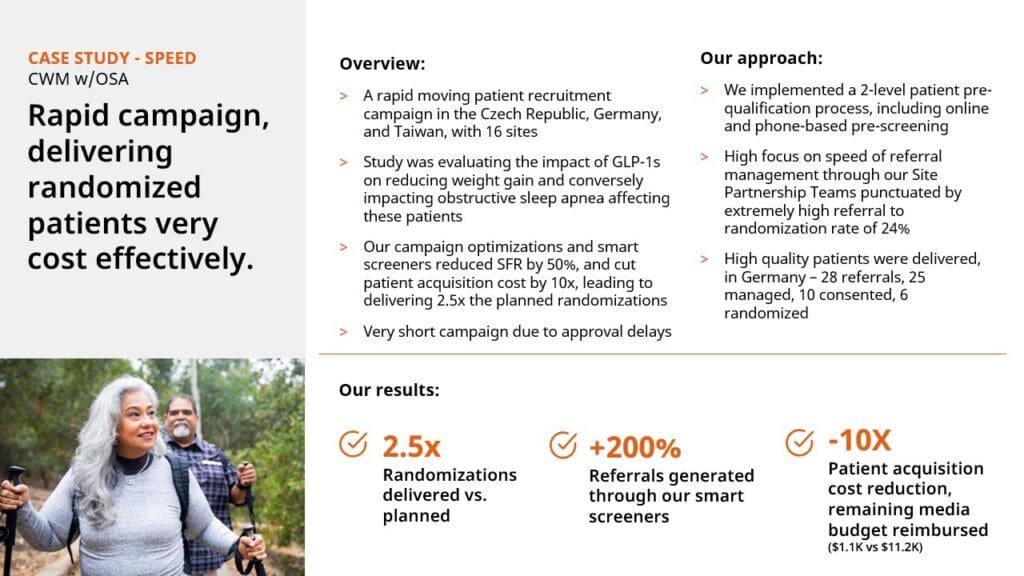
Take a look at our case study to see how the Clariness way increases randomizations, while reducing patient acquisition cost:
Case study: We generated +200% referrals through our smart screening for a Chronic Weight Management with Obstructive Sleep Apnea (CWM w/OSA) trial:
Obesity clinical trials present unique recruitment and retention challenges for patients, sites, and sponsors alike. Addressing these barriers requires patient-centric trial design, thoughtful communication strategies, and operational support for sites.
By combining targeted recruitment approaches with meaningful patient engagement, clinical trials can improve enrollment efficiency, reduce dropout rates, and ultimately accelerate the development of new obesity treatments.
In collaboration with an international sponsor, Clariness achieved a 75% reduction in cost per obesity patient compared to industry standards, operating at just 20% of the typical referral cost.
Planning an obesity clinical trial? Let’s solve recruitment challenges in obesity clinical trials together.Learn how we can support you.