
Even Clinical trial recruitment myths are often blended with some level of truth, but they don’t always hold up in practice. Here are five widely believed clinical trial misconceptions, and the realities exposed by Clariness’ experience.

Myth 1: If we pay sites more, recruitment will improve
Reality: It’s a common assumption that increased financial incentives directly drive patient recruitment attainment at the site level. Payment alone doesn’t solve core bottlenecks, such as limited eligible patient availability or high protocol burden. In simple terms, the pool of ‘interested’ or ‘eligible’ patients may not automatically translate into ‘consented’ or ‘enrolled’ patients.
Clariness has observed similar trends in studies within ‘APOL1-mediated kidney disease’ and ‘systemic lupus erythematosus’, where increased payment reduces friction (to some extent), but it does not automatically create patients, reduce protocol burden or improve eligibility-to-enrollment conversion rate.
Operational simplicity and stronger patient input into protocol design are key levers to seeing reliable performance. Payment matters, but it’s usually not the primary bottleneck.
Myth 2: More sites = more patients
Reality: Having sites in many countries does not mean access to eligible, reachable patients. Even when epidemiology looks favorable, diagnosis rates and their treatment pathways influence whether patients are recruitable through trial sites. In practice, healthcare structures and their regional standard of care (SOC) shapes global feasibility more than geography.
Clariness has typically found enrolment follows the Pareto Law. What should be focused upon is maximizing the performance of high performers and minimizing the impact of sites struggling with their enrolment goals. The same is true in digital recruitment, where cadence management and spend analysis are key to success.

Myth 3: Late-stage trials are easier to recruit for
Reality: Recruitment can actually be more challenging in late-stage trials because competition for the same patient pool is often higher in late-stage trials. In addition, later– phase recruitment can involve tighter eligibility criteria, and a higher participant expectation around risks, benefits, placebo concerns, as well as time commitment. Furthermore, patients might already be undergoing stable treatment, which makes the switch even more difficult.
On the other hand, there is also a growing belief that early-stage trials are easier to recruit as patients receive paid compensation. However, even early-stage trials can get more complex due to the burden of logistics (more assessments, visits, monitoring, etc.) coupled with strong reliance on patient altruism. Additionally, regulators increasingly request comparator groups, which often require more workforce and more patients, thus slowing down recruitment.
Neither late-stage nor early-stage trials should be automatically labeled as ‘easy to recruit’. Both phases come with distinct barriers, which can only be overcome with targeted and strategic recruitment approaches. What we can all agree on is that in a later stage study, the bigger the recruitment problem, the faster you need to act to avoid the snowball effect.
Myth 4: Chronic diseases are easier to recruit for than acute ones
Reality: Patients with chronic diseases are often already on a long treatment journey and may show resistance to changing their treatment. While identification of chronic patients may be easier, long-term conditions can observe reduced motivation and increased protocol fatigue. Thus, more demanding and longer requirements for follow-ups may arise. Recruitment success usually depends more on care pathways and specialist access than on whether a condition is ‘chronic versus acute’.
Clariness has observed this dynamic in inflammatory bowel disease (IBD) studies. In IBD in remission, patients were unwilling to jeopardize remission, preferred to continue their current treatment and found maintenance trials as long and burdensome (e.g., due to repeated colonoscopies). In contrast in acute severe ulcerative colitis, patients often faced limited immediate solutions, high disease urgency, which made clinical trials feel like a potential rescue therapy.
While patients in IBD in remission showed prior negative trial experiences, there was a positive effect of enrollment in acute severe ulcerative colitis. Thus, there was a net effect of faster recruitment in acute severe UC trials, compared to the maintenance-of-remission study.
Myth 5: Digital campaigns work the same way in every country
Reality: Media consumption differs widely across regions in terms of platforms, trust, language and digital habits. At the same time, cultural attitudes to clinical trials also vary, impacting response rates. Often creative materials must be localized for regional relevance, tone, stigma sensitivity etc., in accordance with the targeted country’s specific platforms.
For example, Facebook might be a global social media platform that performs well across many markets. However, for audiences in China, Facebook plays little to no role in reaching patients, as it is not commonly used there. Instead, platforms like WeChat present the most relevant channel for digital patient engagement, however, still only accounts for <5% of Clariness’ randomizations. Our experience instead indicates our carefully curated “boots on the ground” ecosystem has delivered the bolus of patients.
Thus, channels and campaign types that work in one regional market may underperform or even be totally unusable in another. Read our blog on the role of digital marketing in clinical trial success to know more.
Summary
Recruitment rarely comes down to one factor alone. As these myths show, enrollment performance is shaped by protocol design, site capacity, patient realities and market understanding and not assumptions. By challenging common misconceptions early, both sponsors and study teams can plan smarter, reduce delays and improve trial outcomes.
We’ll be debating three of the biggest myths in clinical trial patient recruitment during SCOPE summit 2026.
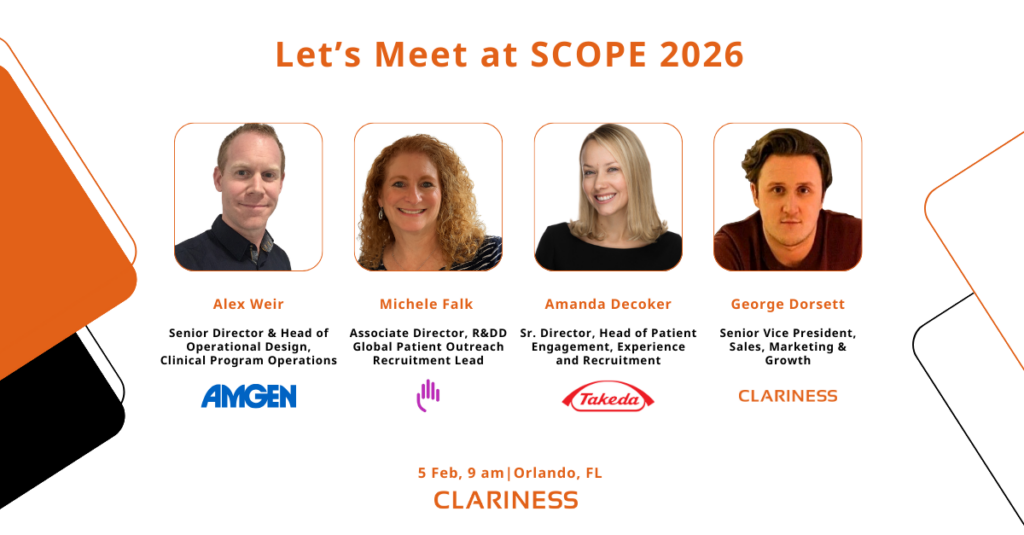
Don’t forget to join us and our host, George Dorsett, (SVP, Sales, Marketing & Growth, Clariness) on February 5th, Thursday, at 9 am.
With over 20 years of experience in patient recruitment across 54 countries, Clariness has leveraged its expertise to support more than 1500+ global studies. We’ve worked with 13/15 leading global pharma companies worldwide.
Talk to one of our experts now and see how we can support your study from start to finish.
Author: Mercy Hapsiba, Content Marketing Specialist | Post Date: 23.01.2026