
World Health Day is celebrated on April 7th; it serves as a global call to reflect on the progress we’ve made in healthcare and the work still ahead.
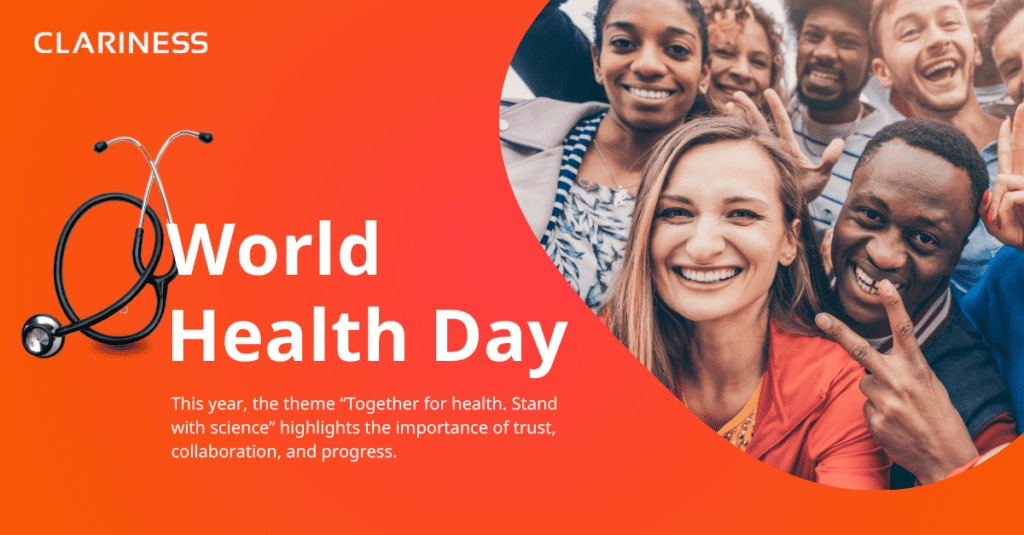
On World Health Day, the 2026 global theme “Together for health. Stand with science” is both a reminder and a responsibility. In a time where scientific progress is accelerating but trust in science is increasingly challenged, healthcare organizations have a critical role to play. Advancing medicine is not only about innovation, but about ensuring that patients can access, understand, and trust the research that shapes their care.
At Clariness, this mission is at the heart of what we do. By connecting patients with clinical trials, we help make medical progress possible, supporting both the development of new treatments and the people who need them most.
To reflect on this, we asked three of our leaders to share their perspectives on what it truly means to ‘Stand with science’ and work ‘Together for health’, and why this purpose continues to drive what we do every day.
Q: What does ‘Together for health’ look like in practice? And how does it influence the way we design and deliver clinical research?
Janine Hart, Chief Operating and Compliance Officer: ‘Together for health’ is very much reflected in the role we play within the clinical research ecosystem. While our work is ultimately with patients, the nature of what we do places us in between patients and clinical sites – two groups that are both essential to advancing healthcare.
In many ways, we stand alongside both. We help connect patients to clinical trials, and support sites in reaching the right participants. That connection is critical, because clinical trials offer patients – regardless of where they are in the world – access to high-quality care, often at gold-standard levels. Enabling that access is, to me, a very real expression of what it means to work ‘Together for health’.
At the same time, collaboration is also about speed and efficiency, by helping to recruit patients into trials in a timely manner, we contribute to accelerating the development of new treatments. The sooner trials can generate reliable results, the sooner we know whether the medication is viable and can be made available more broadly.
So, ‘together for health’ is not just about partnership – it’s about connecting the right people, at the right time, to ultimately bring better treatments to patients around the world.
Q: How can project teams ensure that scientific rigor and patient-centricity go hand in hand? And what keeps teams connected to ‘the why’ of what we do for patients in day-to-day delivery?
Laura Burt, VP Project Management: We can take something as simple as paracetamol for a headache today because someone, many years ago, chose to participate in a clinical trial. Every medicine we rely on exists because of that decision. And when we look at the world today, growing populations and increasing life expectancy, we need to accelerate that progress. If people don’t participate in clinical research now, we must ask, ‘where will medicine be in 30 years when patients need it most?’
That’s why our work matters. To continue that progress scientific rigor and patient centricity must go hand in hand. It’s not just about understanding the protocol, the compound, or how a drug targets a disease, it’s equally about understanding the patient: their journey, their symptoms, and their motivations. Our role is to bridge that gap, translating complex medical information into clear, accessible language so patients can make informed decisions and feel confident participating.
Where challenges often arise is right at the beginning. If patient insights aren’t fully considered during protocol design, it can lead to amendments, delays, and additional burden for both sites and patients. Keeping the patient perspective front and center from the start is essential for smoother, more effective trials.
On a day-to-day level, what keeps teams connected is seeing the real impact of their work. Every patient who consents and participates represents a step closer to bringing a new treatment to even more who need it. That clear connection between our daily efforts and the long-term impact on patients’ lives is what motivates teams and reinforces why we do what we do.
Q: In a time of growing misinformation, what responsibility do healthcare leaders have to strengthen public trust in science? And how does this shape why we do what we do as an organization?
Stefan Mayer-Eggersmann, President and Chief Commercial Officer: In a time where misinformation can spread faster than facts, healthcare leaders carry a profound responsibility to protect and strengthen trust in science. Scientific progress only has real impact when people understand it, feel represented by it, and have confidence in it.
This requires transparency, clarity, and consistency in how we communicate. Science needs to be explained in a way that is accessible, human, and relevant to patients’ everyday lives. It also means taking concerns seriously, addressing misconceptions openly, and ensuring that patients feel informed and respected throughout their journey.
At Clariness, this responsibility shapes everything we do. Our role sits at the intersection of clinical research and patients, where trust is built through every interaction. By making clinical trials more understandable, accessible, and inclusive, we help create an environment where patients feel confident engaging in research.
Strengthening trust in science is an ongoing effort. It is built over time through clear communication, meaningful patient engagement, and consistent delivery. Each patient interaction, each study, and each connection contributes to a broader impact, enabling participation in research and supporting the development of treatments that can improve lives.
A final note for World Health Day
Across all perspectives, one message is clear – progress in healthcare is never achieved in isolation. It requires trust in science, meaningful collaboration, and a constant focus on the people at the center of it all – patients.
At Clariness, this commitment is backed by over 20 years of experience in clinical trial patient recruitment, a global network of 8000+ sites, and more than 42,000 patient randomizations, each one representing a step forward in advancing medical research and bringing new treatments closer to reality.
Whether it is strengthening confidence in research, connecting patients with access to high-quality care, or ensuring that every interaction in a clinical trial reflects respect and empathy, each step plays a role in advancing global health.
“Together for health” is not just a theme – it is a commitment. And standing with science means not only believing in its potential, but actively working to make it accessible, inclusive and impactful.
Because ultimately ‘why we do, what we do’ comes down to one thing: helping bring better treatments to patients, everywhere.