

To mark World Heart Day, we sat down with Dr. Matthias Roos, Director of Scientific Affairs at Clariness, to explore cardiology patient recruitment challenges, including those that originate, or at least can be identified by enrollment feasibility, and what sponsors should examine before scaling recruitment.
First though, let’s look at some key cardiology trial facts:
- At the time of publishing this blog, there are over 6,600 clinical trials and 11,400+ study sites actively recruiting cardiology patients
- A 2025 cardiology report found that cardiovascular diseases account for 68M Disability-Adjusted Life Years (DALYs) across the EU and partner regions, including over 56 countries and 900M people
- Major gaps in cardiology clinical trial representation persist globally, where women (representing 30% of participants), racial minorities (17%), and adults aged 75+ (32%) remain severely underrepresented, despite carrying the heaviest burdens of cardiovascular disease risk and mortality
Dr. Roos explained that typically, when a cardiology trial falls behind its enrollment target, the response from sponsors is often to increase recruitment activity, the three typical actions taken are:
- Expand the patient outreach radius
- Activate and onboard more sites
- Allocate additional media budget
Before taking those steps, though, it is worth examining the assumptions behind the target, and enrollment feasibility from Dr. Matthias’ team helps sponsors and Clariness’ recruitment strategies answer key questions surrounding enrollment, these include:
- Was the eligible patient population accurately estimated?
- Is participation manageable?
- Can the selected sites deliver the projected numbers?
1. Understand your true patient population through benchmarking your protocol’s eligibility criteria
You may know how many patients exist, but do you know how many will actually participate?
The scale of cardiovascular disease can make recruitment targets appear achievable. Yet a large disease population does not establish how many patients qualify for a particular trial, are accessible to its sites, or would consider participating.
Disease severity, comorbidities, concomitant medications, and prior treatment history must be considered alongside competing studies and barriers to participation.
To examine the eligibility requirements behind that distinction, Dr. Roos and his team analyzed 706 phase II and phase III heart failure trials from the past ten years, covering almost 13,000 inclusion and exclusion criteria. Approximately three in four trials had between 5 and 25 criteria, with 15-19 being the most common range.
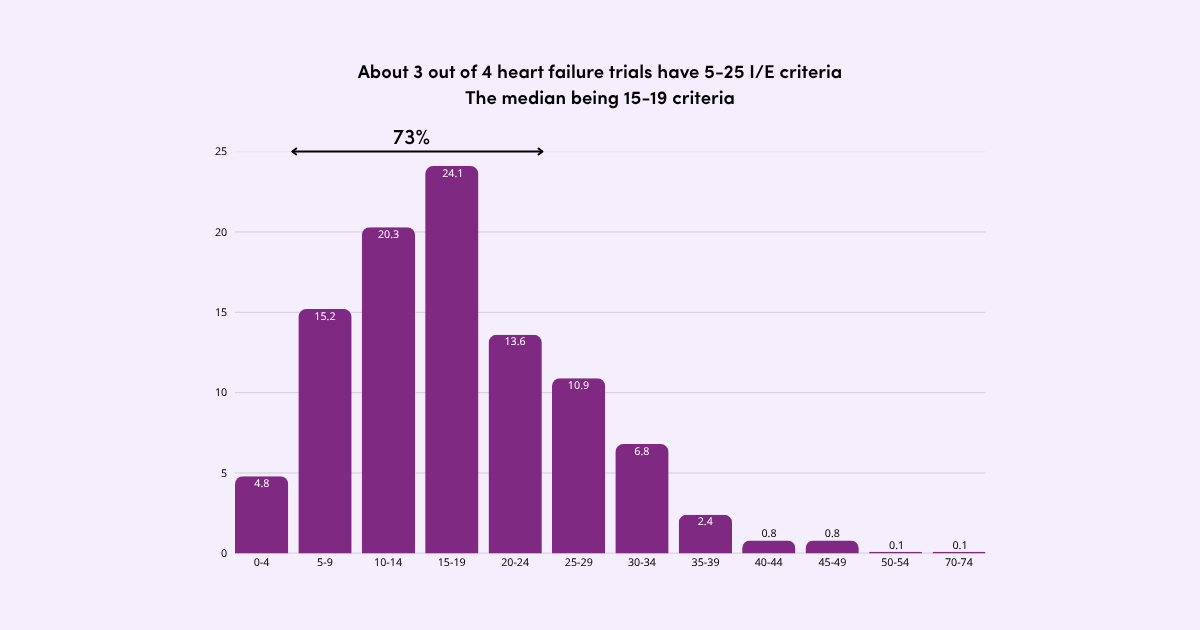
98% of heart-failure trials had between 0-14 inclusion criteria, with more than half of them having 5-9 inclusion criteria. While 92% of trials had between 0-24 exclusion criteria, the median fell in the range of 10-14 (24%).
Exclusion criteria count varied more widely than inclusion criteria counts, highlighting differences between protocols within the same indications.
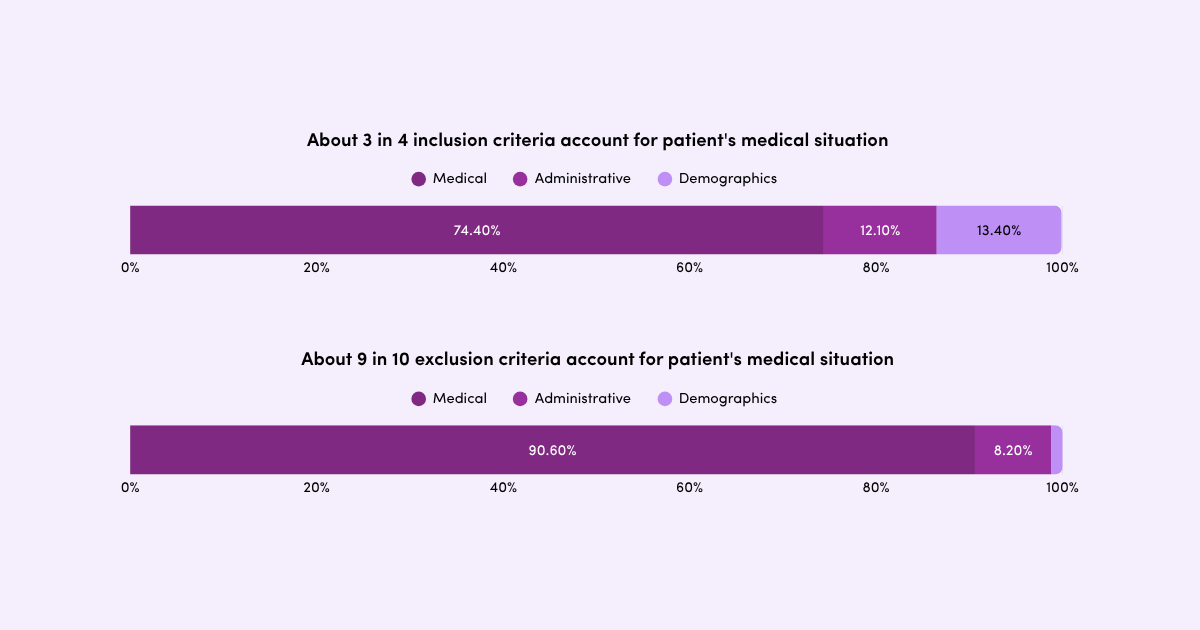
The types of requirements provide further context. Medical factors accounted for 74% of inclusion criteria and 91% of exclusion criteria. These included requirements relating to left ventricular ejection fraction, NYHA functional class, and renal function (eGFR). Demographics represented 13% of inclusion criteria and just 1.2% of exclusion criteria, the remainder concerned reproductive, logistical, or administrative requirements.
The feasibility question is how much each I/E criterion narrows the available patient pool and whether the remaining population aligns with your enrollment targets and timelines. Assessing criteria together helps sponsors identify restrictive combinations and make informed trade-offs before recruitment begins.
2. Assess, quantify and reduce the "patient burden" of your protocol
Your protocol works scientifically, but does it align to the lived reality of your population?
A scientifically sound protocol still needs to be practical for the people expected to follow it. Research by Kenneth Getz and colleagues provides an approach to assessing patient burden by incorporating patients’ ratings of how demanding different trial procedures appear (Getz et al., 2020).
Informed by this approach, Dr. Roos analyzed seven randomly selected heart failure trials, examining the top three perceived visit burdens, these were:
- The number of visits required by patients
- The average duration of site visits
- The duration of trial participation and monitoring
Within the visit-burden assessment, treatment and monitoring emerged as a significant contributor. The treatment and monitoring burden breakdown shown below illustrates why the detail matters. Laboratory tests and bloodwork account for approximately 51% of the assessed burden in the investigated trial, followed by additional requirements and questionnaires at 25%, routine examinations at 18%, and imaging at 6%. Activities that may appear straightforward individually can therefore represent substantial portions of the overall assessment.
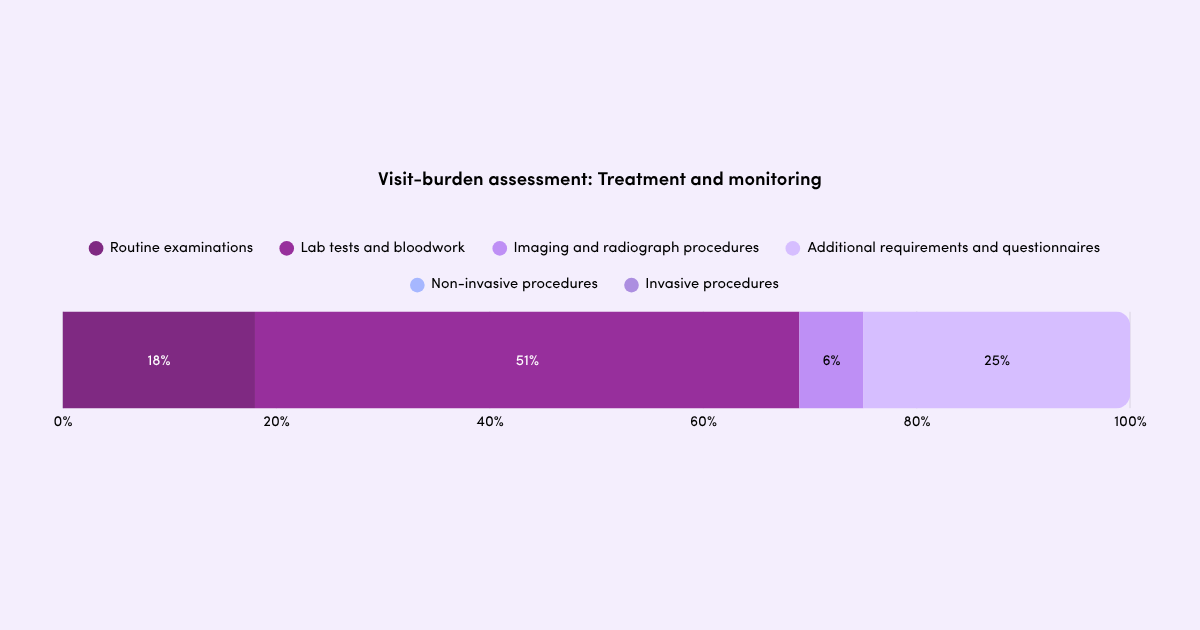
Early patient and site input can help identify difficult visits, transport needs, and opportunities for scheduling flexibility or additional support. When these barriers emerge only after recruitment begins, increased outreach alone may leave the underlying participation challenge unresolved.
3. Give your sites’ patient projections a reality check
A site may treat hundreds of cardiology patients, but how many meet the full protocol, would consider participation, and can be approached and screened within the recruitment window? Guidance from Surgical Research describes this forecasting problem as “Lasagna’s Law:” the anticipated eligible population exceeds the number of patients available for recruitment (Thoma et al., 2010). Historical evidence illustrates the gap between plans and delivery.
A 2012 analysis of 151 global trials found that 52% exceeded their planned enrollment timelines and 11% of sites enrolled no patients (Lamberti et al., 2012). Although these findings are not specific to cardiology, they reinforce the need to examine what supports each site’s estimate. The variation in eligibility requirements across heart-failure protocols further highlights why projections must be specific to the study.
Sponsors should validate estimates through patient-record reviews against the full protocol, enrollment performance in comparable trials, an assessment of staffing and screening capacity, and get real patient and investigator feedback on your protocol.
Competing studies, referral pathways, and site accessibility also need to be considered: a high-volume site may have access to many patients but limited capacity to progress them through screening and enrollment. Pilot recruitment or an initial screening review can test these assumptions before forecasts become operational commitments.
When projections fall short, identifying whether the constraint is patient availability, willingness, or site capacity helps sponsors address the underlying problem and set more realistic enrollment expectations.
Addressing the feasibility gap before expanding recruitment
Reviewing the study’s underlying assumptions is essential to realistic enrollment planning. Understanding who can qualify, what participation requires, and what sites can deliver, helps sponsors direct trial design and recruitment investment in the areas that will make the biggest impact on your enrollment goals.
At Clariness, we combine proprietary data from supporting 2,500 studies with real-world trial datasets to help sponsors quantify and validate enrollment assumptions.
Through ClinSight, we benchmark recruitment timelines, assess patient and site burden, and inform country and site selection. Patient and site surveys, interviews, and targeted feasibility campaigns add direct evidence of eligibility, engagement, and participation barriers, helping translate forecasts into practical enrollment plans.
Want to know how well do your enrollment assumptions reflect the patients and sites your trial depends on? Talk now with our scientific team to check your trial’s enrollment feasibility.
References:
- Lamberti, M., Mathias, A., Myles, J., Howe, D., & Getz, K. (2012). Evaluating the Impact of Patient Recruitment and Retention Practices. Drug Information Journal, 46(5), 573-580.
- Thoma, A., Farrokhyar, F., McKnight, L., & Bhandari, M. (2010). Practical tips for surgical research: how to optimize patient recruitment. Can J Surg., 53(3), 205-210.
- Getz, K., Sethuraman, V., Rine, J., Peña, Y., Ramanathan, S., & Stergiopoulos, S. (2020). Assessing patient participation burden based on protocol design characteristics. Therapeutic Innovation & Regulatory Science, 54(3), 598–604.